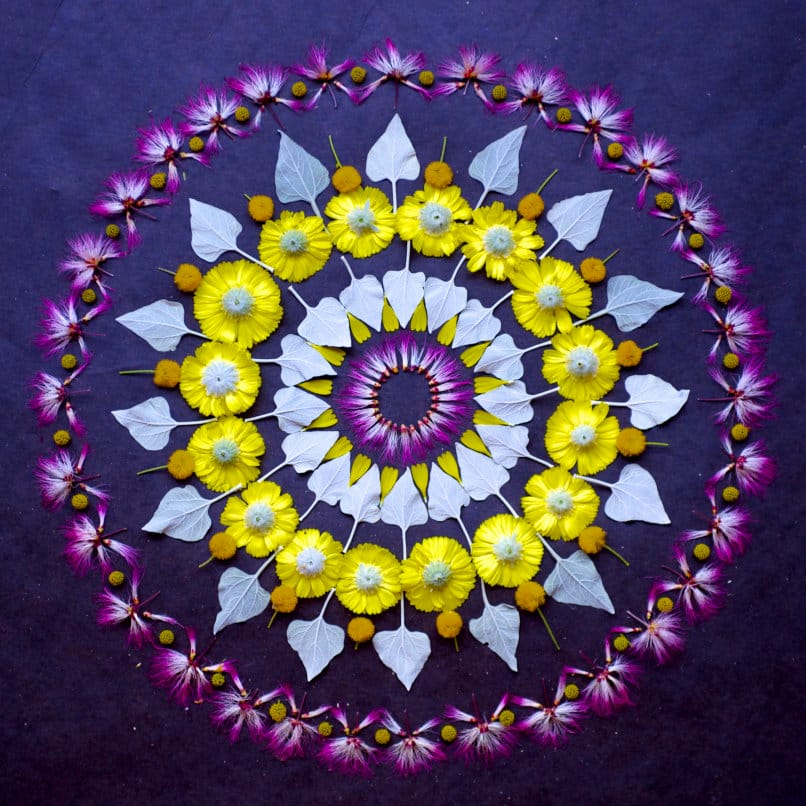
Arizona-based artist Kathy Klein uses a variety of organic materials to produce a series of eye-catching mandalas referred to as Danmalas – a portmanteau of the Vedic Sanskrit words “dan” and “mala” which respectively mean “the giver” and “garland of flowers.” Klein studied both Painting and Art Education at Arizona State University.
 Each piece in her ongoing collection boasts a brilliant sense of geometric symmetry and energetic life.
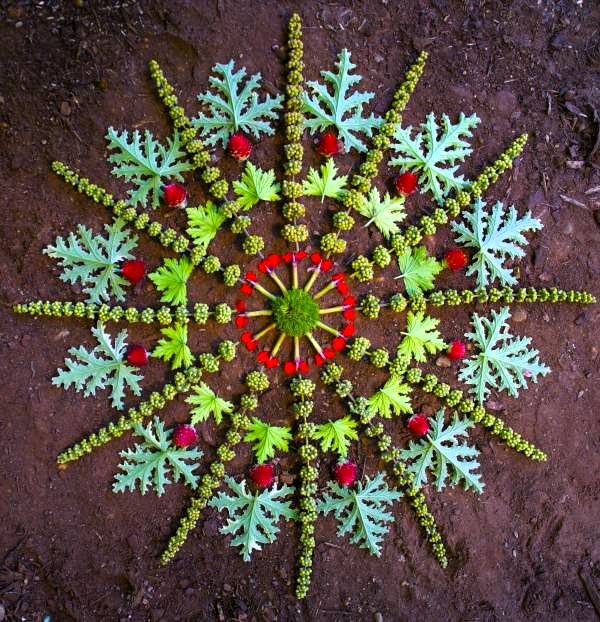 Taking inspiration from traditional Buddhist mandalas, Klein’s danmala’s use shells, seeds, pine cones, rocks, vegetation, and a diverse supply of flowers (including carnations, daisies, goldenrods, hydrangeas, junipers, marigolds, and tulips) to present a circle of symmetry.
 After assembling each visually enriching combination, she leaves it out for anyone to come across.
 There’s a meditative repetitiveness to each creation that is both awakening and relaxing for those who discover her work in person.
 “Mandalas are deeply imbedded in our collective consciousness,” Klein explains.
 “They can be used to describe all of creation and are a reflection of the Sacred, which is inherently present in nature’s perfect geometry.”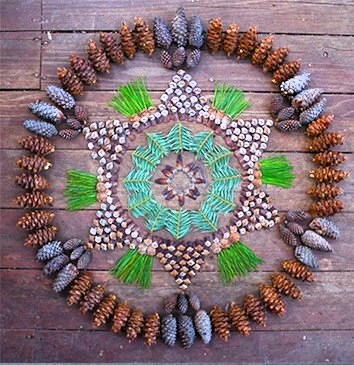
More of Kathy Klein’s magical designs can be found at https://kathyklein.org and https://mymodernmet.com/kathy-klein-danmala/



 Humoring the Goddess