Wolfgang Amadeus Mozart (1756 –1791) was a prolific and influential composer of the Classical period.

Born in Salzburg, Austria, Mozart was a child prodigy capable of playing multiple instruments. At age five he began to compose and gave his first public performance at age six.

Through the years Mozart aligned himself with a variety of European venues and patrons, composing hundreds of works that included sonatas, symphonies, masses, chamber music, concertos and operas, all marked by vivid emotion and sophisticated textures.

The central traits of the Classical style are all present in Mozart’s music: clarity, balance, and transparency, yet simplistic notions of its delicacy mask the exceptional power of his finest masterpieces, including Symphony No. 41 “Jupiter” in C Major, K. 551, Symphony No. 40 in G Minor, K. 550, Symphony No. 36 “Linz” in C Major, K. 425, and Serenade No. 13 in G Major, K 525.
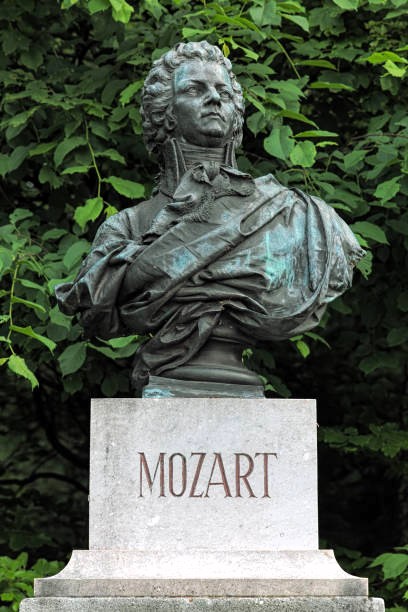
Over the course of his working life, Mozart switched his focus from instrumental music to operas, and back again.

Mozart excelled in the field of opera, including Le nozze di Figaro (The Marriage of Figaro) in 1786, Don Giovanni, 1787, and Die Zauberflöte or The Magic Flute in 1791.
Mozart developed the use of subtle changes in instrumentation, orchestration, and tone color to express or highlight psychological or emotional states and dramatic shifts.

His increasingly sophisticated use of the orchestra in the symphonies and concerti served as a resource in his operatic orchestration, and his developing subtlety in using the orchestra to psychological effect in his operas was reflected in his later non-operatic compositions.

His death at age 35 may have resulted from a number of illnesses. Yet Mozart died penniless and was buried in an unmarked grave.
Despite his short life, his rapid pace of composition and proficiency from an early age resulted in more than 800 works representing virtually every Western classical genre of his time.

More of Wolfgang Amadeus Mozart’s amazing life and music can be found all through the Internet, including https://www.wolfgang-amadeus.at/en/ and https://www.worldhistory.org/Wolfgang_Amadeus_Mozart/.

 Humoring the Goddess
He is my favorite! I especially love Concerto 23.
I wish I could remember where I read this quote — “All genius — and by genius, we mean Mozart…”
LikeLiked by 1 person
He really was amazing. It was an honor to honor him.
LikeLike
Mozart’s music is excellent for listening while painting or drawing.
LikeLike
I’m with you! I play Mozart ) and other upbeat classical music) when I’m crafting all the time!
LikeLiked by 1 person
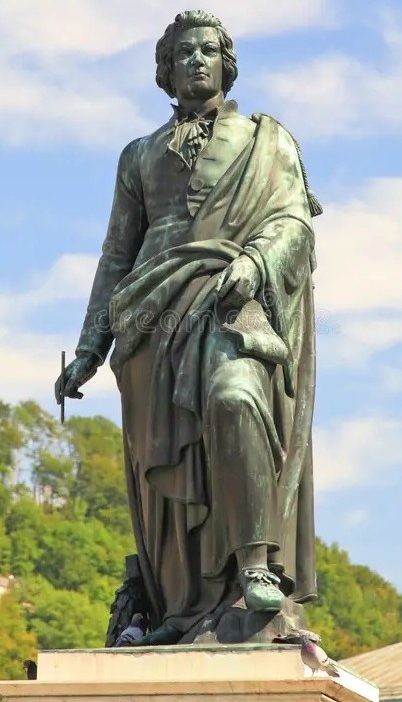
The statue of Mozart In Mozart Square is magnificent and beautiful. Fitting for such a grand artist.
LikeLiked by 1 person
I would love to see it in person!
LikeLiked by 1 person
Been enchanted with Mozart since a I was a wee tike. I recall the Detroit Symphony Orchestra offering young people’s concerts and we attended one for Mozart, highlighting The Magic Flute. I have and use all of the Don Campbell CDs of The Mozart Effect for music therapy, and they WORK! I can only hope that Wolfgang NOW realizes what a blessing he was and still is to this Universe!!!
LikeLike
Again, I soooo agree with you. His work is intricate and fascinating. I wasn’t a classical fan in my early years but have more than made up for it the last 20 years!
LikeLiked by 1 person