I’m Not Paranoid — I LIKE Looking Over My Shoulder


Have you every done something, created something, that, even though it was fun at the time, gave you a feeling that one day it would come back and bite you in the…leg?  I don’t mean those illicit or illegal things you may or may not have drank/smoked/ingested when you were young and stupid.  These are more the things you have done in
the heat of the moment of your adult life that make you look over your shoulder and say…oh dear…what if someone finds out?

Let me explain.  One day I was having a bad day — you know those kinds of bad days — stress and miscommunications and a bout of acid reflex that turned out to be gallstones. Too many projects, too little time. It was a tough moment: deadlines, deadlines, deadlines.  I needed therapy, I needed relief.  Other than finding another job, I needed a way to release all of my pent up emotions so that I wouldn’t start playing a kazoo in the parking lot every morning.

So what does a writer do to release the pressures of every day stress?   We write, of course!  I sat down with my little laptop and wrote this wonderfully twisted short story about sales managers and voodoo symbols and poisoned candied violets.   I had a psycho antagonist and a young, up-and-coming, newly promoted female heroine. I had a clash of egos, a bit of upper class snobbery, and even a twist ending.  It was great writing, great therapy.  So much so that, after polishing it up a bit, I thought about trying to get it published.

It was then that I felt the nibble on my leg.  What if I did get it published?  What if it became a best-selling short story?  What if I actually made money on it?  What if the world — or worse, someone I knew — found out that the story was inspired by them?  It’s kinda like having your best friend buying you a present from her favorite store, something that fits her personality to a T but is a major faux paux in your fashion circle.  She loves it, you hate it.  You think about taking it back to the store to exchange it for something more…you.  So you laugh about it with a friend at a barbecue, and who should appear on the other side of the grill but that same-said friend wearing the same-said T.  What if she heard you?  What if she asks you why you weren’t wearing your “gift”?  What if someone says, “Isn’t that the awful shirt you were just talking about?”  Odds are your friend never heard a word, but…

 This sort of paranoia crosses all generations, all friendships, all common sense. It’s not just a writing thing ― we all get weird when we say something about someone that we later regret, fearing the repercussions that might follow.  We do many things in the throes of passion that make us feel self conscious when we come floating back to reality sometime later. What would happen if the kids walked into the bedroom one night to legs and arms were all over the place when they thought you were out to a movie? What  would happen if we called in sick to work only to run into our boss at the mall? What if, in a fit of rage, we threw a rotten squash out the back door, only to inadvertently smack the neighbor’s dog in the chops?

We have been taught that we have to please everyone, make everyone feel good, even at our own expense.  While that may ring true most of the time, there are times you just need to take a chance on being naughty.  Take a chance on getting caught.  I didn’t mean any harm when I started writing my ditty.  I had always wanted to see if I could write something spooky and revengeful and strange and it was just an accident that the bad guy looked a lot like the co-worker hulking over my shoulder all the time.  I never really meant for the antagonist to resemble my co-worker. Nor would I ever think that he would go out and poison the world because sales were down.  But it made for such darn good fiction!

Maybe I’m just overreacting. The resemblance to any real person, place or publication is purely circumstantial.  Isn’t that what disclaimers are all about? No one I know would read “Horror Daily” or other scary publications and recognize my antagonist  — they are too busy reading gossip magazines.  And anyway, there could always be a dozen other “Claudia’s” in the writing world.  No one would know it was me.  Would they?

So the dilemma is this:  What do I do with this great story now that it’s written?  Do I keep it in a journal, hidden away, only to go back and read it whenever I am under pressure?  Or do I get brave, send it out to contests and publishers and take my chances?  Do I give in to my paranoia, or throw care to the wind and just go for it? 

I think for now I’m just going to let it sit in my computer.  I’ll wait until the pressure is released and the people in my office return to being human again.  Then I will send it out to such obscure publications that there would be no way in Hades he would read it.

I also will remember not to eat any candied violets.

Remembrance: The Goddess Never Forgets

Even though the Goddess chuckles through life, she is deep and sad and without words, too.  Two pictures that make me refocus on the pettiness of my whines…knowing I will pick them up tomorrow, but with a different tint.  Keep your dreams alive and your prayers flowing…the Goddess never forgets.


Frivolous Facts and Faldaral Part II

In Star Wars, The Millennium Falcon was originally modeled after a hamburger with an olive next to it. Because the name of the ship had not been finalized at this time, storyboards refer to as the pirate ship. Some boards indicate for the first version of the pirate ship (which became the Blockade Runner) to be changed into the ‘Hamburger Boogie’ version.  Hans Solo rides off into the galaxy sunset aboard the quarter pounder.

In the movie Carrie, the slow motion scene at the end of the movie was filmed in reverse to simulate ghostlike movement effects. If watched vigilantly, cars can be seen driving backwards in the upper left hand corner of the screen. When I was younger, playing “Strawberry Fields Forever” by the Beatles backwards revealed Paul was dead, too. Alas, I could never get the turntable to turn backwards fast enough to prove anything.

For the movie the Wizard of Oz, Judy Garland was paid $35 a week while Toto received $125 a week. That renubds me of one of my earlier blogs, Diamonds Are A Dog’s Best Friend.

To achieve the sound of thousands of snakes slithering in the movie Indiana Jones and the Raider’s Ark, sound designer Ben Burtt stuck his fingers into a cheese casserole. This was augmented by applying wet sponges to the rubber on a skateboard. Eww. Clever — but eww.

Basil (the herb) was once believed to have the power to breed scorpions. According to one recipe, “three crushed leaves are put under a clay pot. After a few days a tiny scorpion will be born”.  With the help of basil one could also summon scorpions. Pliny, a Roman writer, claimed that a handful of basil pounded with 10 sea crabs would do the trick. What the real connection between basil and scorpions was we will never know. Nor do we want to.

Average number of eggs laid by the female American Oysterer year: 500 million. Usually only one oyster out of the bunch reaches maturity. Those numbers make me itch.

Humans shed about 600,000 particles of skin every hour – about 1.5 pounds a year. By 70 years of age, an average person will have lost 105 pounds of skin. I wonder why that never equates as pounds lost on a diet.

Chocolate syrup was used for blood in the famous 45 second shower scene in Alfred Hitchcock’s movie, Psycho, which actually took 7 days to shoot. The article never said how much chocolate syrup was used. A lot of sundaes went topless that week.

 Jethro Tull is not the name of the rock singer responsible for such songs as “Aqualung” and “Thick as a Brick.” Jethro Tull is the name of the band. The singer is Ian Anderson. The original Jethro Tull was an English horticulturalist who invented the seed drill. Reminds me of the movie Armageddon. Oscar: I tell you one thing that really drives me nuts, is people who think that Jethro Tull is just a person in a band. Psychologist: Who is Jethro Tull?

 During World War II, bakers in the United States were ordered to stop selling sliced bread for the duration of the war on January 18, 1943. Only whole loaves were made available to the public. It was never explained how this action helped the war effort.

 The Mona Lisa has no eyebrows. It was the fashion in Renaissance Florence to shave them off. I wonder if they wore underwear that peeked out of their pants, too. No one would ever know.

When the Mother Ship passes over Devil’s Tower near the end of Steven Spielberg’s Close Encounters of the Third Kind, R2-D2 can be seen hanging from the bottom of the ship.

The carpet designs seen in Sid’s hallway in Toy Story are the same carpet designs seen in The Shining. That’s the creepy side of recycling.

Celery has negative calories. It takes more calories to eat a piece of celery than the celery has in it to begin with. Yum. Or is is it Yuk?

The strawberry flavor in your ice cream contains 50 different chemicals. Nature cannot be imitated, and this is the best example. Just to recreate the flavor of “strawberry”, some fast food companies add 50 different chemicals including benzyl isobutyrate, phenythyl alcohol, amyl acetate, mint and cognac. So, the next time you consume strawberry flavored ice creams, milkshakes or desserts, do remember the recipe. Now that’s not Yum OR Yuk. That’s Ick. Vanilla, please.

A quarter of raw potato placed in each shoe at night will keep the leather soft and the shoes smelling fresh and clean. They forgot to add that if you don’t take the potato out it turns into potato toe jam.
In 1939, the Hollywood Production Code dictated what could and could not be shown or said on screen, and Rhett Butler’s memorable last line in the famous Gone With the Wind, presented a serious problem. A few of the suggested alternatives were “Frankly my dear… I just don’t care,” “… it makes my gorge rise,” “… my indifference is boundless,”  “… I don’t give a hoot,” and “… nothing could interest me less.” Although legend persists that the Hays Office fined Selznick $5,000 for using the word “damn”, in fact the Motion Picture Association board passed an amendment to the Production Code on November 1, 1939, to insure that Selznick would be in compliance with the code. Henceforth, the words “hell” and “damn” would be banned except when their use “shall be essential and required for portrayal, in proper historical context, of any scene or dialogue based upon historical fact or folklore … or a quotation from a literary work, provided that no such use shall be permitted which is intrinsically objectionable or offends good taste.” With that
amendment, the Production Code Administration had no further objection to Rhett’s closing line, “Frankly, my dear, I don’t give a damn.”  Which is a damn good thing.

And, finally…..for those of you with time on your hands….

 If you counted 24 hours a day, it would take 31,688 years to reach one trillion!

May the Horse Be With You

          A friend of mine works at a wild animal sanctuary.  The work is hard and dirty, and the pay non-existent, as she is a volunteer.  At first glance you would think she scrapes out stalls and washes animals mostly because she is a Good Samaritan; because she wants to help animals who have seen better days. While this is true, she also works with the animals so she can give them space to share their stories, often sharing ones of her own.

            Nash is one of her favorites. He is a cougar who was used by a gang for protection, much like a guard dog.  Chewie is a camel, donated because he was to be slaughtered and fed to the wild cats as he had severed rear leg tendons.  And RC, her favorite, is a blind horse. RC came from a place that forced her to live in filth, which was the eventual cause of her blindness.  My friend listens to their stories, working with them to bring a bit of peace and comfort to their world.  And she swears when she look into their eyes she can hear them talking back.

            There is no hocus pocus here— there is no run away imagination or desperation for someone to talk to. Sue is a down-to-earth, hard working, funny friend that just happens to listen better than a lot of us.  You hear animals too – you just don’t realize it. How many times has your cat looked up at you and meowed, and, without thinking, you ask, “What do you want?” as if you expected an answer?  How many times have you gauged what your dog wants by the speed of their wagging tail or the perkiness of their ears? How can you figure out the difference between wagging for food and wagging to go outside and wagging for pets?

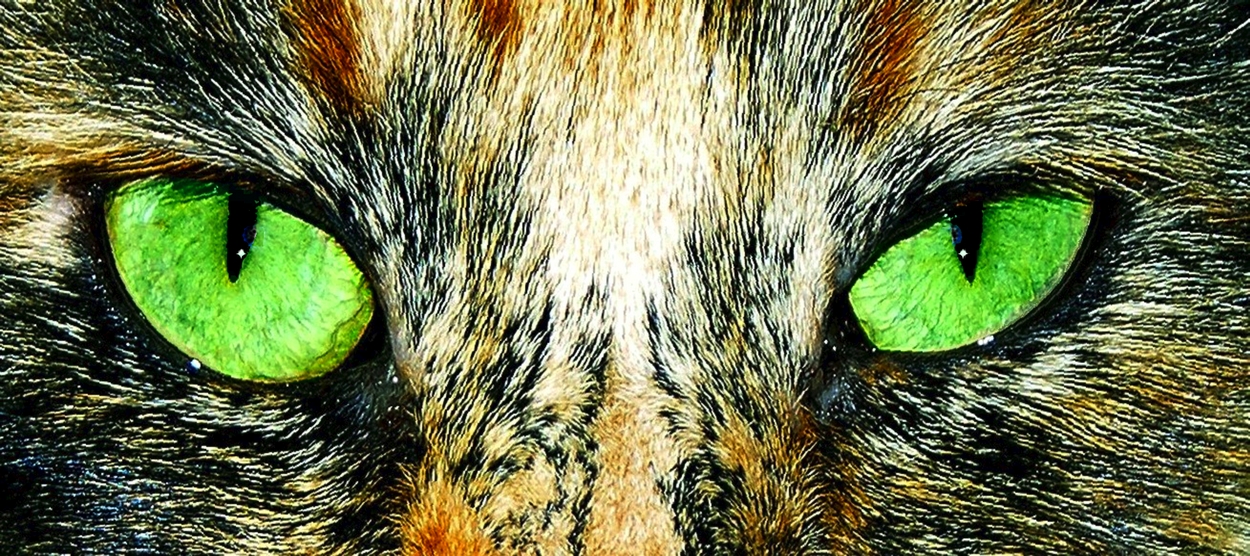
             Like Pavlov’s Dog (no pun intended), many interactions are learned through repetition, through action and reward. Animals don’t have the capacity to think at the same level as humans; they merely remember what gets them fed or pet and repeat these acts over and over again so that you, in your personification, believe they are thinking and speaking. But regardless of all scientific explanations, there are still plenty who connect with animals on all sorts of levels.  Some are upfront and obnoxious about their rapport; others never admit to conversations with anything lower on the food chain than themselves.  But there is something about the presence of animals, domesticated or not, that touches us in indescribable ways.  The connection is on an energy level that cannot be detected by scientific methods. You have to admit, the moment you look into the eyes of your dog or cat or the lions at the zoo, they look back and you feel something deep and primal.

            Oh, we say we listen — to our friends, our spouses, to our bosses and our kids.  But do we?  How often do we stop and really listen to what they’re saying? How many times does someone start to talk and, before you know it, your mind has slipped forward to what’s for dinner or a song you can’t get out of your head? How many times do we look into each other’s eyes and feel what’s truly there? Experience the unspoken energy?  Not as often as we could; not as often as we should.   We are too busy, too stressed, too tired, to stop the chatter in our head and listen to what’s being said, both verbally and non-verbally, by those around us. We don’t mean to not listen —we do care about others.  We care about how they feel, what they think, what they do.  But we have forgotten how to slow our lives down and listen —to feel the cosmic energy being sent our way.  There is no place we need to be so quickly and desperately that we need to cut off the current between another who is trying to connect.  We don’t have to connect forever — just long enough to make a difference in their lives.

            I’m not saying we should try and communicate with every chicken or cow we see, or every butterfly that passes by.  But who’s to say there’s not a basic need in all life forms be understood? To be accepted?  Even if for a nanosecond? Maybe it’s not a conscious thought; maybe it’s more primal than that. Maybe it’s just instinct. The instinct of comfort, of the instinct of contentment.

          In the long run, it really doesn’t matter if communication with animals is real or not. What matters is we need to think of others besides ourselves. We need to slow down and not over-think and over-analyze everything. In their simplicity, animals remind us of who we once were.  Of where we came from.  We came from a world that was quieter, simpler than the madness we experience these days.  And slowing down, communicating with animals, and each other, is worth the time you take.

           When my friend nuzzles RC, the blind horse, she may not be looking into his eyes, but she is feeling his energy, his story, his gratitude.  He thanks her for taking the time to brush him, feed him, to nuzzle him. She doesn’t care if this exchange can be measured by scientists — all she knows it that she is making the horse feel better, and in the act of listening, feels better herself.

            Not too long ago my cat of 18 years passed away. It was a gradual thing, old age and kidney shutdown all part of the cosmic circle. I spent a lot of time talking to her those last days.  I told her stories about our younger days, reminded her that I was there, and that we’d always share our energies in the form of memories. I don’t know if I made her passing any easier, but in listening to her breathing, I heard her story, I shared her life. 

            My life is better for it.  Yours will be, too.